KVM DVI Switches: Why So Expensive!?
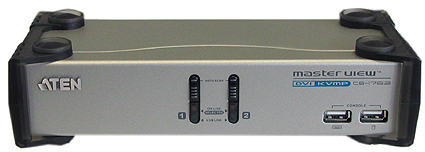
Right now I’m using a Dell 24-inch screen with my hand-built Windows box. But I also have a 13-inch Macbook that I’ve been using for school and software development (Unix is simply a nicer environment than Windows). I’ve been wanting to get the Mac on the 24-inch screen, but I only have a mini-dvi to DVI adapter. So I was thinking of getting one of those nifty KVM switches that let you use one set of input devices for multiple computers.

A KVM switch that supports DVI video inputs costs like, $175! Why so expensive!? I’m not an electrical engineer (or computer engineer even), but it doesn’t make sense that the hardware can cost so much. Couldn’t you just rig something up that just physically “switches” the wiring? Maybe the switch requires some power, but I can’t imagine the logic being that terribly complex. In comparison, a lot of the VGA KVM switches I’ve looked at cost maybe $25. What’s the difference, besides a few extra signals being re-routed?

So my short term cheapo fix will probably be to buy a $19 Mini-dvi to VGA adapter for my Macbook. My monitor has multiple inputs (VGA, DVI, Component, Composite, S-Video) so I can just switch from VGA to DVI for Mac to PC. The video quality might suffer, but I probably won’t be able to tell the difference anyway (my older brother claims he can).

4 Responses to “KVM DVI Switches: Why So Expensive!?”


  1. 1 Ender

    Paying $30-40 for a non-DVI KVM switch is already highway robbery from a technological standpoint, but not many ordinary consumers use them anymore. Add on DVI capability to the switch, and you have an even smaller pool of people who are interested - since like you said, a lot of folks can’t distinguish the difference in visual quality. At least, that’s my theory.

  2. 2 Hung

    I know cables in general are scams. I wasn’t sure about switches. I mean, they’re just switches! I learned about those in my circuits class way back when! I just figured they might have something special in them that requires some kind of thought. Maybe not. I guess it could just be demand vs. supply vs. no one buys these so jack up the price!

  3. 3 Rex

    The cost of KVM switches, it’s all depending on the grade of components and functions KVM manufacturers put on it accordingly.

    For example, for the DVI KVM switch, there are DVI-I, DVi-D, Dual-link or Single-link … different DVI standards. If the DVI KVM switch can only support DVI-I spec, them it will cost less than KVM switch can support Dual-link DVI-D which can support much higher in video resolutions and it’s all “digital” instead of “I” for “Integrated analog and digital”. The other important factor will be the chip sets (both DVI chip and USB chip) the makers put on their switches.
    Some IC chips cost even triple than the low-end one.

  4. 4 Richard

    In some ways you guys are right, a switch can be made to go from one computer to another quite easily and cheaply and it will work, probably, some of the time, might need to re-set it every now and then, video quality might not be up to much, will be some problems with compatibility here and there but then what do you expect for $25?

    However, getting a switch that minimises the degradation of the video, will not fall over, is compatible with ALL keyboard and ALL mice, supports DDC and two page EDID information to ensure there are no issues with your graphics card is complicated and is expensive and we’ve not even introduced DVI into the equation. DVI is very expensive and very complicated. A single DVI-I signal is equivalent to about 4.5Gbps of data which is one of the reasons it is so difficult to extend much more than about 30ft with out having to introduce some sort of compromise. A cheap DVI switch (and $175 is a cheap one, our cheapest will set you back $500) will have to have made some compromises in its design but most home users pottering about on the web and doing some photo editing (low frame rate) will not notice. Start playing games or playing high resolution video through it and all of a sudden you will realise why it only costs $175.

    My company specialises is ‘no-compromise’ KVM solutions and our customers include military, broadcast and media and CGI film producers, they won’t touch a $175 DVI switch with a very long stick. It is very complicated and very difficult to get right. It always amazes me that people wil spend $2000 on a PC, $500 on a display, $300 on a graphics card and hook it up through a $25/175 switch and complain that it is expensive!

Leave a Reply